
Bear Markets Come in All Shapes and Sizes
Submitted by Bernhardt Wealth Management on October 5th, 2020Considering the rather remarkable comeback of the equity markets from their drastic drop this past spring, it would be hard to make the case that we are in a bear market presently. While the indexes continue to exhibit a fair amount of headline-driven volatility—most recently demonstrated by the sharp intra-day drop in response to President Trump’s COVID-19 diagnosis—they remain within a few percentage points of the all-time highs achieved early this year, before news of the coronavirus pandemic sent them tumbling.
But as anyone knows who has been involved with the financial markets for any length of time, bear markets do happen. The one this past spring was particularly violent, but possibly short-lived, if current trends continue. Others have played out more gradually and required more time to climb back into bullish territory. In all cases, investors who remained patient, focused, and disciplined have done relatively well over time.
A recent article on Morningstar.com gives a good overview of bear markets over the last century and a half. These downturns range from the 1929 crash that announced the onset of the Great Depression to the relatively quick drop that happened during the Cuban Missile Crisis of 1962. Over that long time period, bear markets (defined as a 20% decline in the major indices) occurred roughly every nine years. Each time, obviously excepting the present one, the markets eventually recovered to achieve new highs, but some—as you can see from the accompanying chart—took much longer than others.
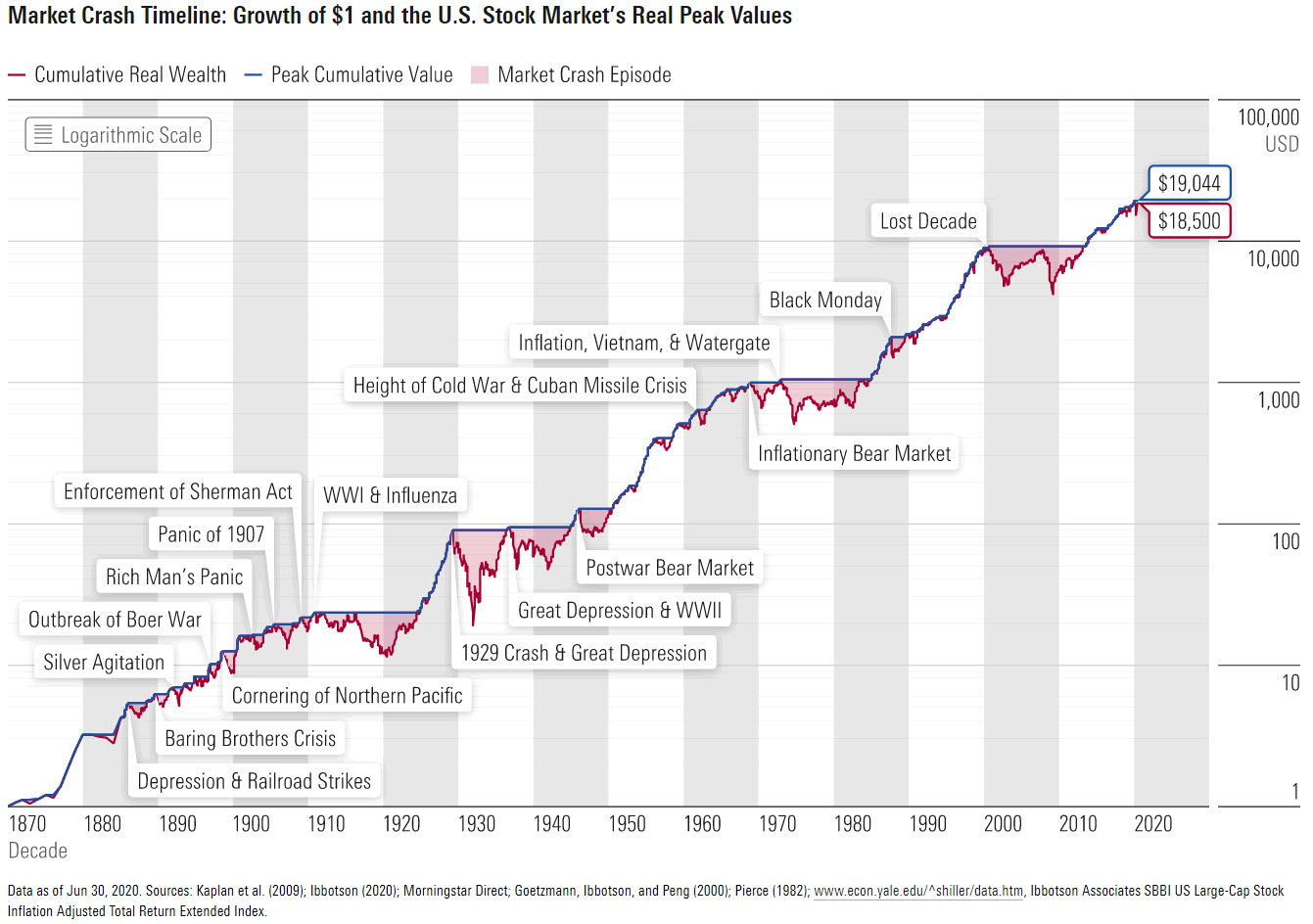
The article ranks all 17 bear markets according to the length from the beginning of the downturn until the time when the index had recovered to the same level, and also takes into account the severity of the decline. So for example, an investor holding equities at the beginning of the bear market beginning in August of 1929 would have experienced a 79% decline in the value of his holdings, and wouldn’t have gotten back to even until November of 1936—seven years later. The next bear market started the following February, and saw another 49.93% drop, so this was a pretty painful time to be invested.
In contrast, the Black Monday crash starting in August of 1987 saw a downturn of 30.21%—pretty scary, until you consider that an investor would have been made whole less than two years later, in July 1989. The downturn associated with the Cuban Missile crisis barely qualified as a bear market; investors experienced a 22.80% decline, and were back where they had been before a year and a half later.
We all know, of course, that everything looks different in the rear-view mirror. Investors experiencing these market downturns—including the one that started last February—weren’t able to predict where the bottom would form or how long it would take to get back to where they were, much less to see further gains. But it is worth remembering that over the last 150 years, a one-dollar investment in the US equity market would have grown to $18,500 by the end of June 2020. As you can see from the chart, we are far from experiencing the pain of some of the more severe downturns of the past, and overall, staying invested through the scary times has turned out to be a winning strategy.
One moral of this story is that perspective is a key component of a sound investing strategy. As professional, fee-only financial planners and advisors, we employ that informed perspective in the service we provide our clients. If you think you could benefit from that type of help, please contact us. And to read our recent article, “The Importance of Stress-Testing Your Wealth Strategies,” please click here.
