“How Long Will It Take?” Portfolio Performance and the Current Market
Submitted by Bernhardt Wealth Management on March 30th, 2020As we have been communicating with clients extensively over the last three weeks during this extremely volatile market, we have been deeply encouraged by the generally calm attitude most have maintained, despite the markets being anything but! Understandably, however, many clients—especially those in retirement—have asked for our thoughts about how long the current downturn in equities could last, and more importantly, how long it might take for their portfolios to recover.
These are important and perfectly logical questions. When we watch stock prices drop dramatically, as they have since mid-February, it’s only natural to wonder when prices will find a bottom and begin their recovery. History has shown us that this always happens, but of course, it can’t tell us exactly when.
In this particular instance, what the markets most want to see—even more than the massive $2 trillion Coronavirus Aid, Recovery, and Economic Stability (CARES) Act just passed by Congress—is evidence that the virus is being contained and the pandemic is coming to an end. All of the stringent efforts at quarantine, social distancing, cancellation of sporting events and other large gatherings, and closing of non-essential businesses are aimed at achieving that outcome, and we all need to continue to do our part.
But as for the financial markets, history does offer some clues about what we might expect over the next months and years. This chart from Dimensional Fund Advisors illustrates total returns following steep declines for one, three, and five years following the decline.
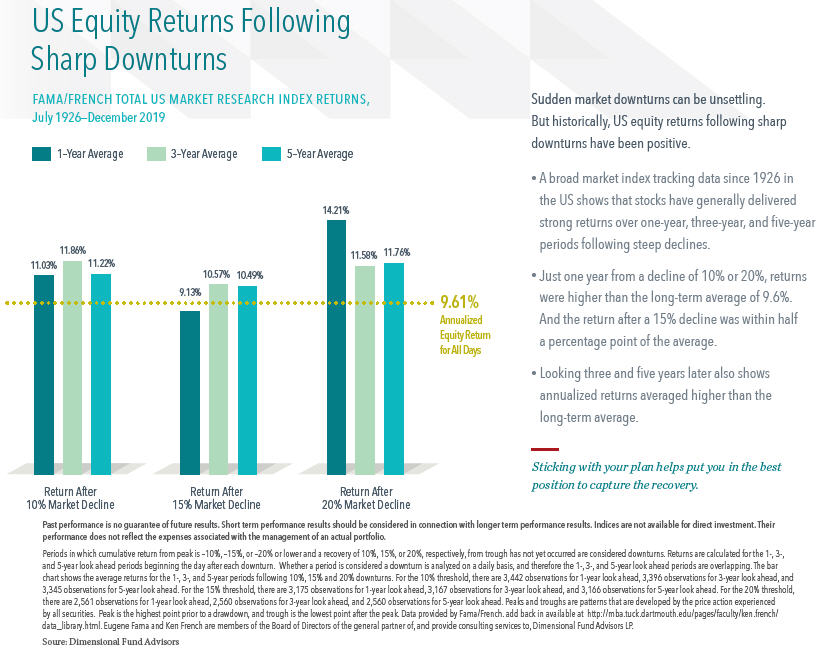
Notice that the chart shows market returns, 1926–2019. After a 10% market decline, the average one-year return was just over 11%, the average 3-year return was almost 12%, and the average five-year return was 11.22%. When the market declined as much as 15%, the one-year average was 9.13%, three-year was 10.57%, and five-year was 10.49%. In the case of a 20% decline, all returns were greater: 14.21% after one year, 11.58% after three years, and 11.76% after five years.
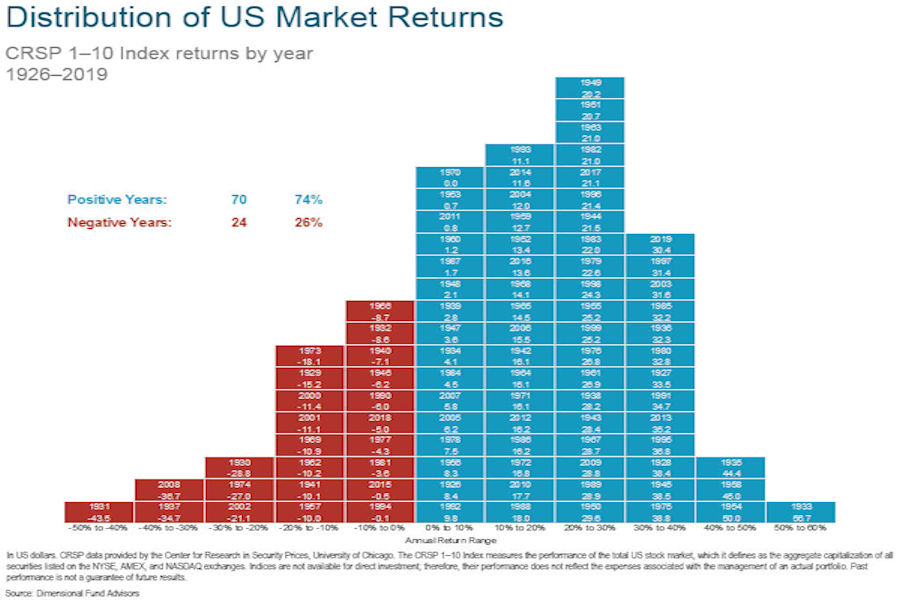
This suggests that for patient investors who stick with their long-term strategy, it is realistic to expect equity values to recover and resume their long-term upward trajectory. In fact, as this graphic from Dimensional indicates, since 1926, 74% of the time, equity markets have ended the year higher than they began, while 26% of the time, one-year growth has been negative. In other words, stocks tend to rise more often than they drop. That doesn’t make those drops any less gut-wrenching, but at least they are less frequent than the positive years.
While we cannot know for certain the length of the current market downturn, we can reasonably believe, based on history, that it will resolve and prepare the markets for the next upturn. Also based on history, we might reasonably expect most portfolios to approach their valuations from the previous market peak within three to five years. It’s also worth remembering that for well-diversified portfolios with an appropriate mix of equities and fixed-income investments, the decline of the major stock indexes is not directly reflective of portfolio values. Even if a client was 100% invested in stocks—which very few are—the Dow and other well-publicized indexes do not precisely mirror the value of a well-diversified global portfolio. And for those holding a mix of equities and fixed income, the cushioning effect of non-equity investments is even more evident.
In closing, we hope you’ll consider these five ingredients for long-term success in this, and any market:
- Create an investment plan that fits your needs and risk tolerance;
- Structure your portfolio along the dimensions of expected returns;
- Diversify globally;
- Manage expenses, turnover, and taxes;
- Stay disciplined and patient through market dips and swings.
These are the principles that we follow for every client portfolio at Bernhardt Wealth Management. It is our privilege to serve you, and if you have questions or want advice on anything concerning your investments or the current markets, we sincerely invite you to contact our office.
