
The Importance of Stress Testing Your Wealth Strategies
Submitted by Bernhardt Wealth Management on October 1st, 2020When making decisions about your money, it can be smart to know the steps that extremely affluent individuals and families take to grow and protect their significant wealth.
Take stress testing, for example. Stress testing is a process that carefully examines your current wealth planning strategies to assess the likelihood that they’ll deliver the results you expect them to in various environments and  situations.
The Super Rich (people with a net worth of $500 million or more) often have stress tests conducted because the tests enable them to make smart decisions, to verify that they likely will get what they want and to confirm they are dealing with the right professionals. They can also be effective at identifying potential big problems—or possible huge mistakes—so changes can be made proactively.
The good news: You don’t have to be outrageously wealthy to benefit from a stress test. In fact, we believe it should be part of most people’s due process when vetting financial plans, products and services. In addition to identifying potential missteps in an existing plan or service, it may be able to deliver some peace of mind to the client when the test confirms that a plan is indeed on track.
How stress testing works
A stress test often follows a defined process involving four main steps:
1. Profiling. The process starts with discovery. What are your specific goals and concerns? What problems do you want to solve? What opportunities are you seeking to benefit from?
2. Solution evaluation. Once there is clarity about your goals, objectives, concerns and limitations, various strategies or products can be assessed. There are numerous ways to dissect and evaluate solutions, including:
- Working the assumptions. The assumptions underlying the strategies or products are systematically modified to determine how they are likely to work when the “what ifs” of the scenario change.
- Evaluating alignment with goals and objectives. It’s essential to determine whether the strategies and products likely will accomplish your goals and objectives. A solution might be high quality but still not deliver the specific results you want or need.
3. Analytic comparisons. Based on the evaluation, alternative solutions might be considered. It can be very useful to conduct analytic side-by-side comparisons of the solutions.
4. Recommendations. At the conclusion of stress testing, recommendations are presented and considered—and the next course of action is decided on.
Stress test trends among advisors
Because of the power of stress testing, leading professionals are increasingly making it a cornerstone of the way they work with individuals and families.
Consider that a sizable majority—76.8 percent—of 181 senior executives at multifamily offices (organizations that serve wealthy families) call stress tests an important deliverable for their clients.*
By and large, we see those stress tests being focused primarily on investment management solutions, with other areas like life insurance and wealth planning getting attention to varying degrees.
In our view, this intensive focus on investment management may be too limiting. For example, while just around 40 percent of the executives have stress tested clients’ life insurance, a full 64.4 percent of those execs uncovered problems that required corrective actions.
This doesn’t surprise us. Many affluent families purchase life insurance to address estate tax concerns. Sometimes, life insurance is obtained to create a larger estate or to make a charitable gift at death. Other times, the intent is to benefit from the tax-free internal buildup. But it’s common that some of these affluent families end up with amounts of life insurance that exceed their wants and needs. Additionally, their life insurance may be poorly structured. When life insurance portfolios are not in sync with wealth planning strategies, trouble can occur down the road.
This suggests that stress tests should be widely applied to other areas of clients’ financial lives.
Growing in importance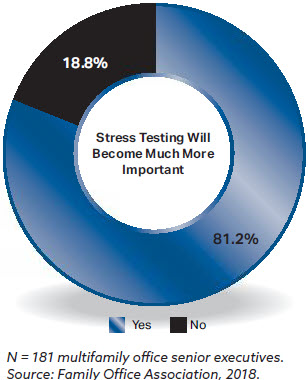
It’s reasonable to expect stress testing to garner more interest and attention among clients and their advisors, as evidenced by the fact that more than 80 percent of the executives said these tests will become more important going forward (see the chart at right).
Consider one way that stress testing can add value: evaluating income tax mitigation strategies. Today, there are a number of ways to lower corporate and personal incomes (and thereby pay less in taxes). The wealthy may look to stress test these strategies in order to ensure they are not running afoul of revenue services in any way with their approaches.
More access
Stress testing, once a feature available mainly to the wealthiest among us, is increasingly being offered to a broader range of individuals and families. As a result, you may have an opportunity to put your financial and legal strategies and plans through their paces and determine if they’re set up to deliver the results you want.
Next step: Reach out to your financial and/or legal professional to see if a stress test would be a good idea.
*Family Office Association, 2018
